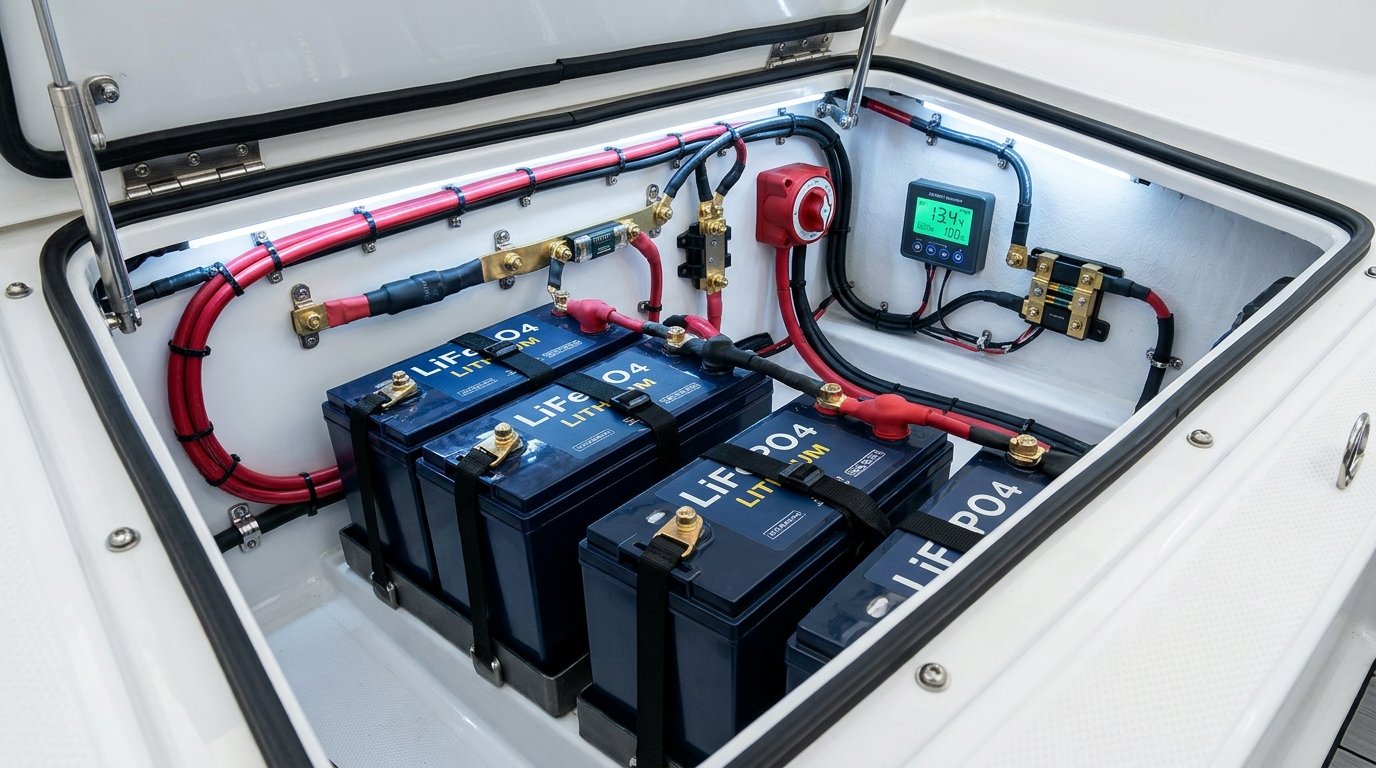
Reliable power on the water depends entirely on proactive, disciplined marine battery care. Unlike automobiles that merely start an engine and drive, boats demand distinct electrical duties: supplying hundreds of cranking amps to spin high-compression marine outboards, while simultaneously powering heavy continuous house loads like GPS chartplotters, livewell pumps, radar domes, and stereo amplifiers for hours with the engine off.
This comprehensive marine battery care guide analyzes Flooded Lead-Acid, Absorbed Glass Mat (AGM), and Lithium Iron Phosphate (LiFePO4) chemistries, multi-stage smart charging algorithms, state-of-charge testing, and off-season storage techniques.
Marine Battery Chemistries: AGM vs. Lithium LiFePO4 vs. Lead-Acid
| Battery Chemistry | Usable Depth of Discharge (DoD) | Cycle Lifespan | Weight (per 100Ah) | Key Marine Advantages |
|---|---|---|---|---|
| Flooded Lead-Acid (Wet Cell) | 50% max discharge | 300 – 500 cycles | 60 – 65 lbs | Lowest initial purchase cost; requires regular distilled water topping |
| Absorbed Glass Mat (AGM) | 50% – 60% discharge | 500 – 800 cycles | 65 – 72 lbs | 100% spill-proof, vibration resistant, low self-discharge, zero acid fumes |
| Lithium Iron Phosphate (LiFePO4) | 80% – 100% usable | 3,000 – 5,000+ cycles | 25 – 28 lbs (60% lighter) | Fast charging, constant 12.8V voltage delivery, integrated internal BMS safety |
Starting vs. Deep-Cycle vs. Dual-Purpose Batteries
A fatal mistake in boat ownership is using an engine starting battery for house electronics:
- Starting (Cranking) Batteries: Built with thin, spongy lead plates that maximize surface area to discharge brief bursts of massive current (800+ Marine Cranking Amps). However, repeatedly deep-discharging a starting battery damages the plates, ruining the battery in under 30 cycles.
- Deep-Cycle Batteries: Constructed with thick, solid lead plates designed to discharge steady current over hours down to 50% state of charge. Essential for trolling motors, livewell pumps, and anchor windlasses.
- Dual-Purpose Batteries: A compromise featuring medium plate thickness. Excellent for single-battery runabouts, but inferior to dedicated split starting and house banks on larger boats.
Multi-Stage Marine Charging Best Practices
Modern marine batteries require smart multi-stage charging algorithms to maximize battery lifespan:
- Bulk Stage (Constant Current): The charger delivers maximum amperage until the battery reaches roughly 80% capacity (typically 14.4V to 14.7V for AGM).
- Absorption Stage (Constant Voltage): The charger holds voltage steady while gradually tapering current to finish the final 20% charge without boiling electrolyte.
- Float Stage (Maintenance): Voltage drops to a gentle 13.2V to 13.6V maintenance level to counteract natural self-discharge during storage without overcharging.
Lithium LiFePO4 Note: Never connect lithium batteries to an old lead-acid charger that features an automatic high-voltage “desulfation” or “equalization” mode (15.5V+). This high voltage triggers the internal Battery Management System (BMS) over-voltage disconnect. For certified engineering specifications, consult official protocols published by ABYC E-10 and E-11 marine battery guidelines.
Terminal Care & Off-Season Storage Protocols
- Never Use Wing Nuts: American Boat and Yacht Council (ABYC) E-11 standards prohibit wing nuts on marine battery terminals. Engine vibration loosens wing nuts, creating high electrical resistance, voltage drop, and arcing. Always use stainless steel nylon-insert locknuts torqued with a 1/2-inch wrench.
- Preventing Parasitic Drain: Stereo memories, bilge pump auto-float sensors, and VHF standby circuits slowly drain batteries over weeks. Install a heavy-duty battery disconnect switch (1, 2, BOTH, OFF).
- Winter Storage: Fully charge batteries before layup. Stored lead-acid batteries discharge 3% to 5% per month; a discharged battery freezes and cracks at 20°F, whereas a 100% charged battery will not freeze until -80°F. See our boat winterization guide and explore our marine electrical systems 101 guide.
When planning your annual budget, accurate marine battery care metrics help you avoid unexpected expenses and extend vessel longevity.
Frequently Asked Questions About Marine Battery Care
How can I tell if my marine battery is dying?
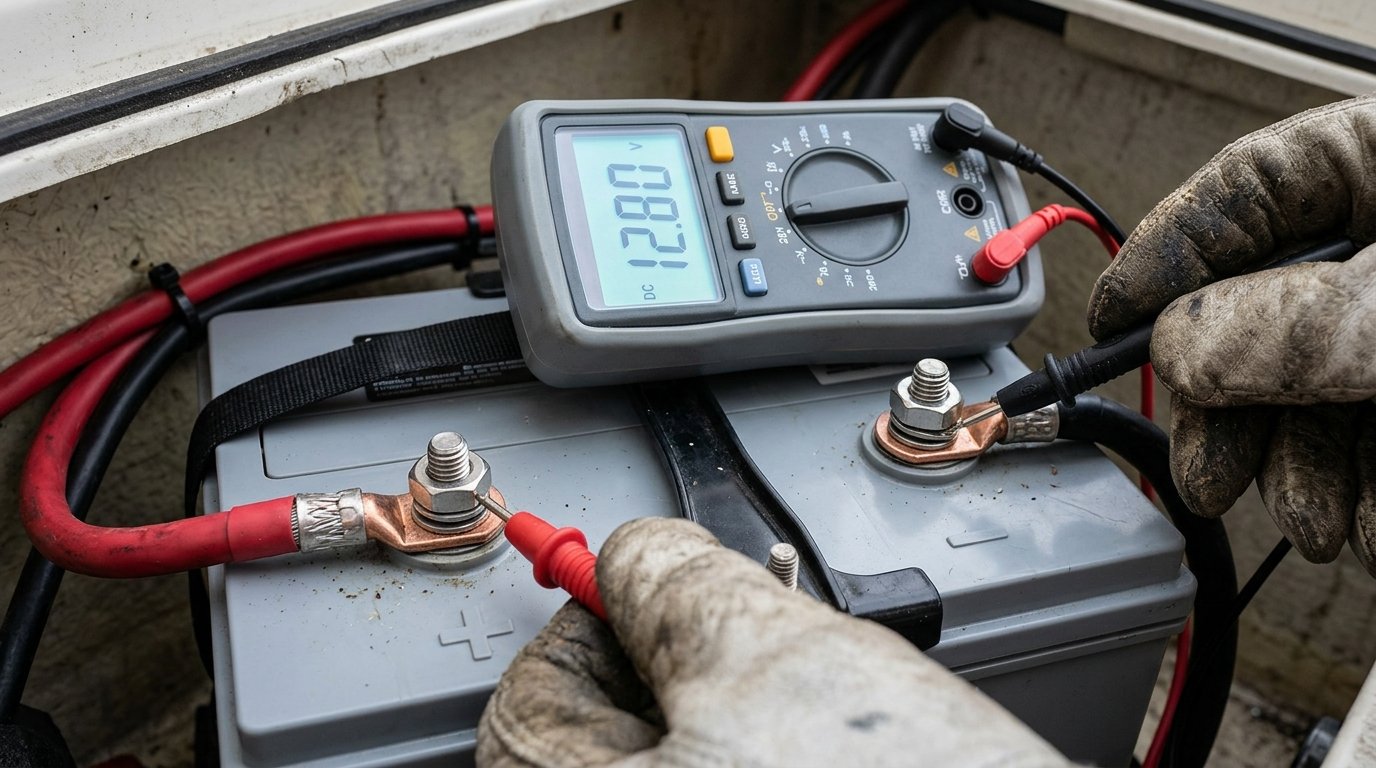
Test the open-circuit rest voltage with a digital multimeter after the battery has rested for 12 hours. A fully charged 12V AGM battery should read 12.8V to 13.0V. If voltage drops below 12.2V (50% charge) rapidly under light load or fails a carbon-pile load test, internal plates have sulfated and the battery requires replacement.
Can I charge my marine lithium battery with my outboard engine alternator?
Yes, provided you verify alternator compatibility. Modern Mercury and Yamaha outboards can charge LiFePO4 cranking batteries approved for starter duty (such as those with high-discharge BMS systems). For house banks, install a DC-to-DC marine charger to prevent burning out the outboard’s alternator regulator.
What causes marine battery terminal corrosion?
White or blue-green crust on battery terminals is caused by hydrogen gas venting out of flooded battery posts and reacting with brass or copper cable lugs in moist saltwater air. Clean terminals with baking soda and water, wire brush the lead clean, and seal with dielectric marine grease.
Can I leave an on-board marine battery charger plugged in all winter?
Yes, provided it is a modern microprocessor-controlled smart charger with a dedicated “float” and “storage maintenance” profile. Smart chargers continuously monitor temperature and cycle off when batteries are full, preventing water boiling and dry out.
Published by Boat Maintenance Guide Electrical Desk. Inspected in accordance with American Boat and Yacht Council (ABYC) E-10 and E-11 battery standards. For certified engineering specifications, consult official protocols published by ABYC E-10 and E-11 marine battery guidelines.
Following this proven marine battery care strategy protects your marine investment, enhances safety on the water, and minimizes unexpected mechanical repairs. For ongoing maintenance schedules and certified specifications, revisit our marine battery care recommendations each season.