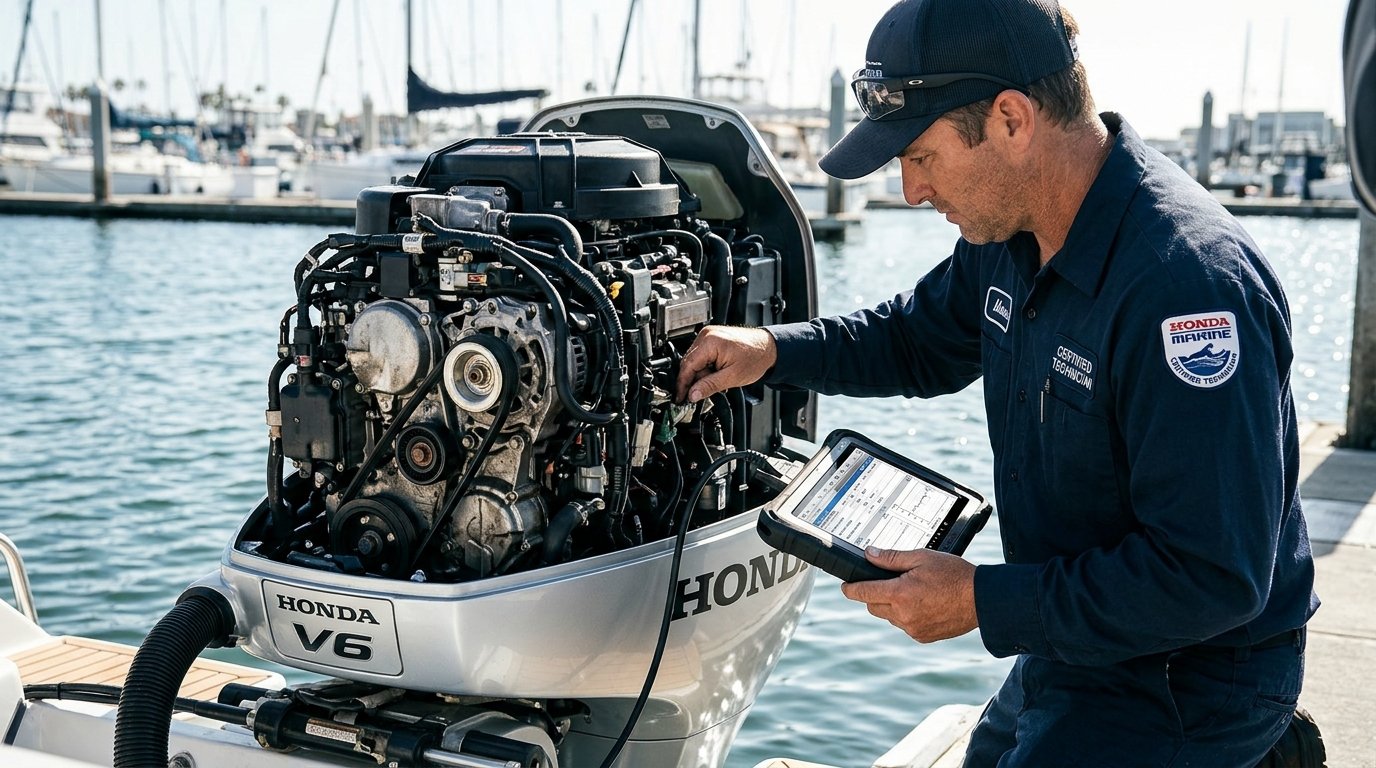
Pioneers of four-stroke marine propulsion, Honda Marine outboards are celebrated across the boating industry for automotive-derived engineering, legendary fuel efficiency, and quiet refinement. Borrowing bulletproof engine blocks and VTEC variable valve timing from automotive legends like the Honda Accord and Civic, models like the BF90, BF150, BF225, and BF250 deliver exceptional longevity. However, disciplined Honda outboard troubleshooting is essential when warning buzzers sound or fuel delivery faults arise.
Whether you are dealing with a starter that spins without catching, a sudden power cut above 4,000 RPM, or confusing 4-lamp indicator alarms at the helm, this comprehensive Honda outboard troubleshooting diagnostic guide provides certified mechanical procedures to isolate faults and restore peak performance on the water.
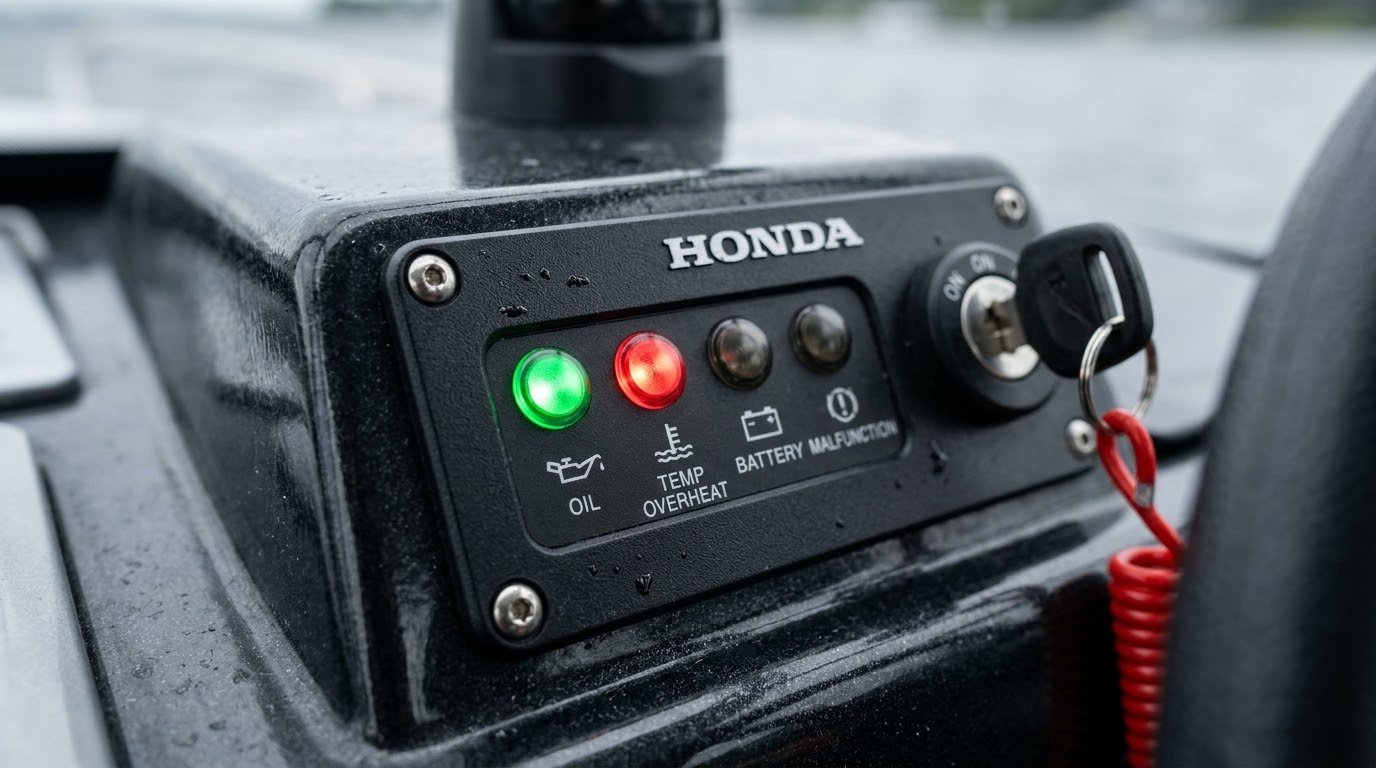
Decoding the Honda 4-Lamp Helm Alert Panel
Unlike other outboard brands that rely solely on audible buzzers, Honda outboards feature an intuitive 4-lamp alert panel integrated into the key switch or digital gauge cluster. During your Honda outboard troubleshooting sequence, observing these lights reveals immediate diagnostic clues:
| Indicator Lamp Status | Audible Buzzer Signature | Fault Condition | Engine Guardian Action |
|---|---|---|---|
| Green (Oil Pressure) Lamp Goes OFF | Continuous loud horn tone | Critical Low Engine Oil Pressure (Below 23 PSI) | Guardian drops engine speed to 1,800 RPM. Shut down engine immediately! |
| Red Overheat Lamp ON | Continuous loud horn tone | Cylinder Head Temperature Exceeds 200°F (93°C) | RPM limited to 1,800 RPM. Shift to neutral immediately to idle and cool down. |
| Red Check Engine (MIL) Lamp ON | Intermittent beeping tone | Sensor Failure (O2, MAP, ECT, or TPS fault) | Engine operates in fail-safe limp-home mode with reduced top-end timing. |
| Red Battery Charging Lamp ON | Silent (No buzzer) | Alternator Output Below 12.0 Volts | Alternator belt loose, blown 90A fuse, or faulty voltage regulator. |
Starting Problems & Ignition Interlocks
If your Honda outboard refuses to turn over or cranks briskly without firing, inspect these electrical checkpoints before disassembling mechanical components:
- Emergency Kill Switch Clip: Verify that the red plastic lanyard clip is pushed completely under the toggle button. Even a 1mm gap grounds the primary ignition circuit, resulting in strong starter cranking with zero spark to any cylinder.
- Neutral Safety Switch: Remote control cables on Honda binnacles stretch over time. If the shift arm inside the engine cowl does not hit the microswitch dead-center, the starter solenoid will remain completely silent. Wiggle the throttle lever back and forth while turning the ignition key.
- The 90-Amp Main Engine Fuse: Located under the black electrical junction box on the port side of the engine, this large bolt-down fuse protects the ECM and starter relay. If blown by reversed battery cables, the entire engine electrical system will be dead.
Fuel System: High-Pressure VST & Low-Pressure Lift Pumps
Ethanol fuel phase separation is the primary cause of mid-range surging and bogging on Honda marine engines. When conducting Honda outboard troubleshooting for loss of high-speed power:
- The Low-Pressure Lift Pump: Mechanically operated by a camshaft lobe, this pump draws fuel from the boat gas tank into the Vapor Separator Tank (VST). Squeeze the manual primer bulb while the boat runs at cruising speed; if pumping the bulb restores power, the mechanical diaphragm has ruptured.
- The High-Pressure VST Filter: Mounted directly underneath the electric fuel pump inside the aluminum VST tank is a micro-fine mesh intake screen. When fuel sits over winter, gum and varnish block this filter. Remove the VST drain screw; if cloudy amber fuel or water drops drain out, the VST must be opened, cleaned, and reassembled with a fresh OEM seal gasket.
- VTEC Solenoid Screen (BF150 / BF225): On VTEC-equipped models, variable valve timing engages at approximately 4,500 RPM via hydraulic oil pressure. If engine oil level is low or the tiny mesh filter inside the VTEC spool valve solenoid is clogged with sludge, VTEC cannot engage, causing the engine to hit an artificial RPM wall at 4,300 RPM.
Cooling System: Thermostats & Impeller Care
Honda outboards utilize dual thermostats on V6 engines (one for each cylinder bank) operating at 140°F (60°C). Salt crusting causes thermostats to stick open (preventing normal warm-up and causing oil dilution) or stick closed (triggering overheat alarms). When performing cooling maintenance:
- Inspect the telltale “pisser” stream; clear salt deposits using a piece of heavy monofilament fishing line.
- Replace the rubber water pump impeller every 100 operating hours or 12 months. Never start the engine dry without water flusher muffs attached.
- Follow maintenance guidelines published by Honda Marine Official Maintenance.
Compare diagnostic procedures across manufacturers by consulting our comprehensive outboard motor troubleshooting guide, our Yamaha outboard troubleshooting guide, and our Mercury outboard troubleshooting guide.
Frequently Asked Questions About Honda Outboard Troubleshooting
How do I read check engine diagnostic flash codes on a Honda outboard?
Locate the red 4-pin service check connector near the ECM wiring harness under the engine cowling. Using a small jumper wire, short the service check terminal to ground, and turn the ignition key to ON (engine off). The red check engine lamp will blink diagnostic trouble codes (DTCs)—long flashes represent tens, and short flashes represent single digits (e.g., 2 long flashes and 3 short flashes indicate Code 23: Knock Sensor).
Why is my Honda outboard “making oil” (oil level rising on dipstick)?
A rising oil level with a strong gasoline odor indicates fuel blowby past the piston rings into the crankcase. This is almost universally caused by a stuck-open cooling thermostat that prevents the engine from reaching operating temperature (causing the ECM to inject rich fuel continuously) or a pinhole leak in the mechanical low-pressure fuel pump diaphragm.
Can I clean the Honda VST filter or does it need replacement?
On smaller Honda models, the fine mesh screen can be rinsed thoroughly with aerosol carburetor cleaner and reused if the mesh is intact without tears. On larger V6 models with high-micron paper element VST filters, replacement with a genuine Honda OEM filter is mandatory to maintain 40+ PSI fuel rail pressure.
Why does my Honda outboard alarm beep once when I turn the key on?
A single short beep combined with all four alert lamps illuminating for two seconds when you turn the key to ON is the normal electronic self-test sequence. It confirms that the warning buzzer speaker and indicator LEDs are functioning properly before starting.
Published by Boat Maintenance Guide Certified Marine Mechanics Desk. Inspected in accordance with Honda Marine FourStroke Service Manuals and ABYC standards.


