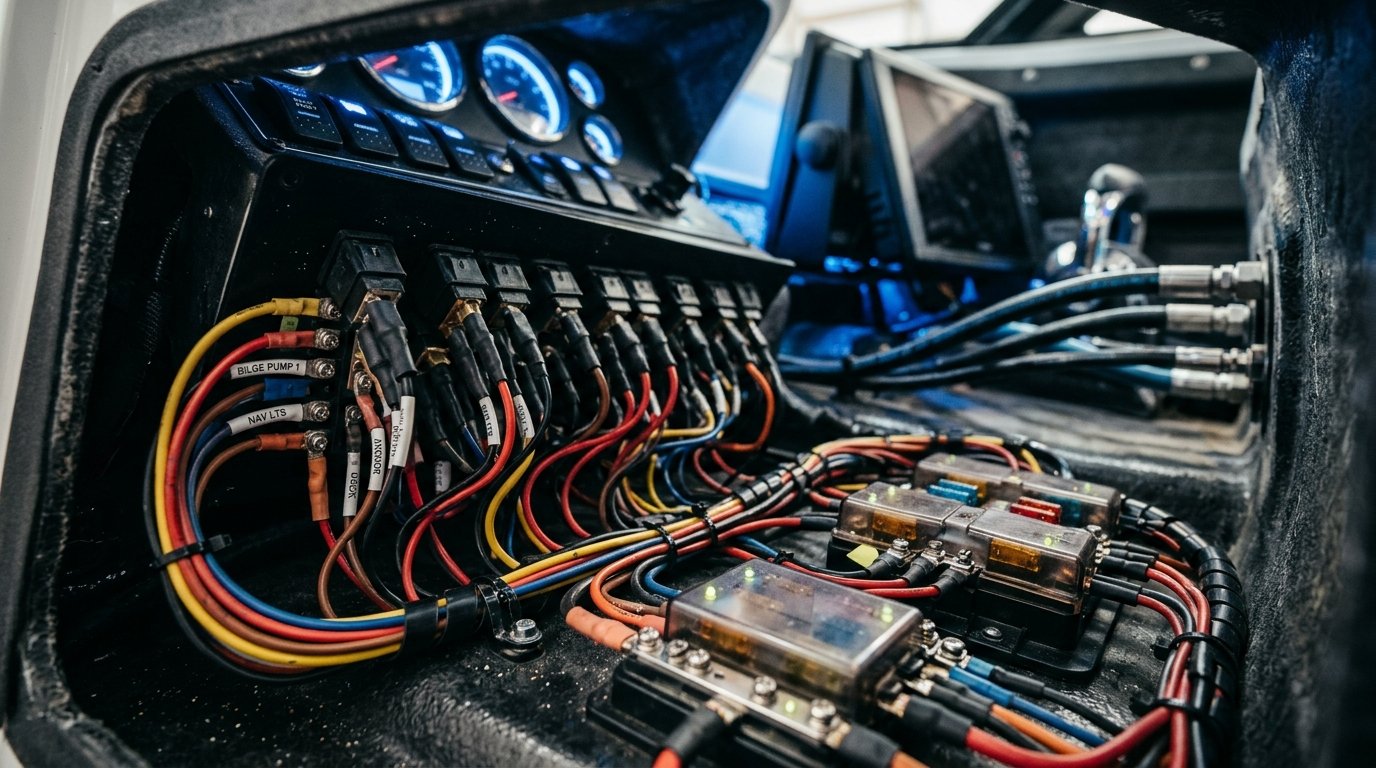
Understanding the fundamentals of marine electrical systems is essential for every boat captain who values onboard safety, reliability, and fire prevention. The marine environment is extraordinarily hostile to electrical wiring: constant vibration shakes connections loose, moisture causes galvanic corrosion, and raw fuel vapors in the bilge turn single loose electrical sparks into catastrophic vessel fires.
This beginner-to-advanced marine electrical systems guide details American Boat and Yacht Council (ABYC E-11) color coding standards, tinned copper wiring rules, switch panel installation, circuit protection sizing, and diagnostic multimeter techniques.
ABYC Standard Marine DC Color-Coding Chart
| Conductor Insulation Color | ABYC Circuit Designation | Voltage & Standard Application |
|---|---|---|
| Red | DC Positive (+) Mains | 12V / 24V ungrounded main battery feed to distribution panels |
| Yellow (or Black) | DC Negative (-) Ground Return | Negative return to engine block or negative busbar. Yellow is modern standard to avoid confusing with AC Black hot wire. |
| Brown | Pumps (Bilge & Livewell) | Automatic float switches and manual bilge pumps |
| Dark Blue | Navigation Lights & Courtesy Lighting | Bow red/green lights, masthead all-round white anchor light |
| Purple | Ignition Switched Power | Instrument gauges, tachometers, alternator field excitation |
Why You Must Never Use Automotive Wire on a Boat
One of the most dangerous DIY errors in recreational boating is using automotive primary wire or household electrical components:
- Tinned Copper Conductors: Marine boat cable (UL 1426 certified) consists of finely stranded copper conductors where every individual copper strand is electroplated with pure tin. If moisture penetrates the jacket, untinned automotive copper oxidizes into brittle green copper carbonate that breaks, whereas tinned copper resists corrosion for decades.
- Vibration-Proof Stranding: Marine wire utilizes high-strand-count Class K flexibility. Stiff solid-core household wire quickly snaps from the repetitive pounding of boat hulls slamming against wave chop.
- Ignition-Protected Components: Starters, alternators, fuses, and bilge switches must meet SAE J1171 marine ignition protection standards. This ensures that any electrical arcing inside the component cannot ignite explosive gasoline fumes lingering in the bilge.
Fuses, Circuit Breakers & Voltage Drop Calculations
Fuses are installed to protect the wire from melting and catching fire, not to protect the electronic device. According to ABYC standards, every ungrounded DC positive conductor must feature circuit protection (fuse or circuit breaker) located within 7 inches of the power source (or within 72 inches if the wire is enclosed in protective conduit).
Calculating Maximum Permissible Voltage Drop:
- Critical Circuits (3% Max Voltage Drop): Navigation lights, bilge blowers, electronic chartplotters, and VHF marine radios must not exceed 3% voltage drop (maximum 0.36V drop on a 12V system). Running undersized wire causes GPS units to reboot when you key the radio microphone or start engines.
- Non-Critical Circuits (10% Max Voltage Drop): Cabin courtesy lights, freshwater pumps, and stereo speakers can safely tolerate up to a 10% voltage drop.
- Round-Trip Length: When sizing wire gauge using ABYC ampacity tables, always calculate the total round-trip distance (from the battery to the switch, out to the light, and all the way back through the negative ground wire).
Marine Switch Panels & Heat-Shrink Connections
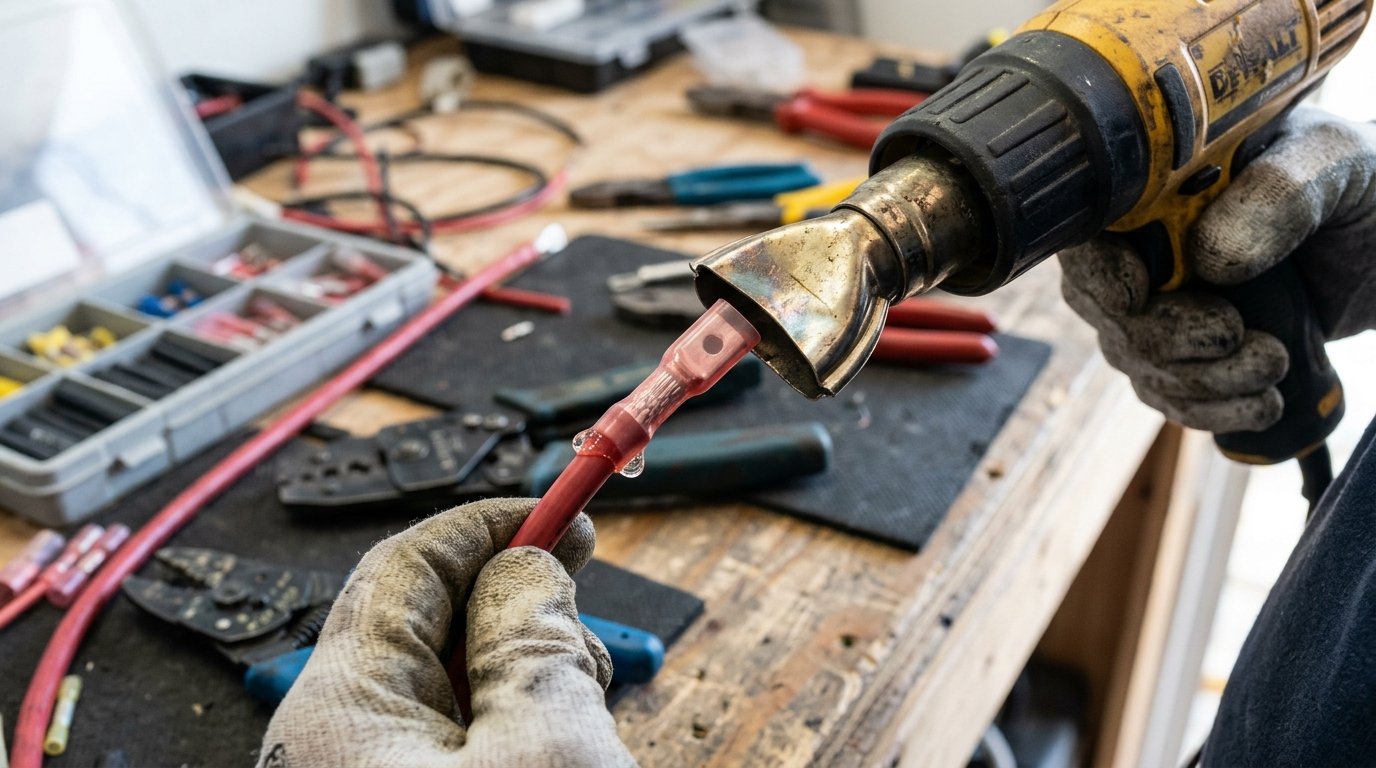
Quality electrical connections are sealed connections. Never use automotive plastic twist wire nuts or unsealed crimps. Always use marine-grade nylon insulated crimp terminals with heat-activated adhesive sealant lining. When heated with a heat gun, the adhesive melts and oozes out of the crimp collar, creating a 100% waterproof airtight seal that completely locks out saltwater moisture.
Explore our companion guides for marine battery care and outboard motor troubleshooting for ignition wiring diagnostics.
When planning your annual budget, accurate marine electrical systems metrics help you avoid unexpected expenses and extend vessel longevity.
Frequently Asked Questions About Marine Electrical Systems
What is the difference between AC and DC grounds on a boat?
On boats equipped with 120V AC shore power, the AC safety green grounding wire and the DC yellow/black negative system must be tied together at a single central bonding point (usually the engine block). This ensures that if an AC short circuit touches an engine or metal hull fitting, the circuit breaker trips instantly rather than electrifying surrounding water with lethal stray current.
Why does my boat radio or chartplotter turn off when I start the engine?
Starter motors draw massive electrical current (150-250A), temporarily causing battery bank voltage to dip below 10 volts. Sensitive modern marine electronics possess internal low-voltage cutoffs that shut the unit down to protect microprocessor memory. Separating house loads onto a dedicated deep-cycle battery bank via an Automatic Charging Relay (ACR) eliminates this issue.
How do I test for a parasitic battery drain with a multimeter?
Turn all boat switches, key ignitions, and bilge accessories off. Disconnect the negative battery cable. Set your digital multimeter to the DC Milliamps (mA) scale and connect the meter probes in series between the negative battery terminal and the disconnected cable clamp. Any reading above 50mA indicates an active parasitic short or stuck accessory switch slowly draining your battery.
Can I solder marine electrical wires instead of crimping?
No. ABYC standards explicitly state that solder cannot be used as the sole mechanical connection on marine wiring. Soldering makes stranded wire rigid; boat engine vibration quickly snaps the wire right at the edge of the stiff solder joint. Always use properly calibrated ratchet crimping tools with adhesive heat-shrink terminal lugs.
Published by Boat Maintenance Guide Electrical Systems Desk. Inspected in accordance with American Boat and Yacht Council (ABYC) E-11 AC and DC Electrical Systems standards. For certified engineering specifications, consult official protocols published by American Boat and Yacht Council (ABYC E-11 AC and DC).
Following this proven marine electrical systems strategy protects your marine investment, enhances safety on the water, and minimizes unexpected mechanical repairs. For ongoing maintenance schedules and certified specifications, revisit our marine electrical systems recommendations each season.