Safe boating begins long before your hull splashes into the water; it starts on the highway. Executing proactive boat trailer maintenance is the single most effective way to prevent catastrophic roadside axle failures, locked brakes, flat tires, and ramp launching disasters. Boat trailers operate under extreme punishment: bearing hubs heated by 65 mph highway friction are repeatedly plunged directly into freezing lake water or corrosive saltwater.
This comprehensive boat trailer maintenance inspection guide covers wheel bearing repacking protocols, hydraulic surge brake maintenance, submersible LED light wiring, and structural frame corrosion prevention.
Boat Trailer Maintenance Checklist & Inspection Intervals
| Component | Inspection Frequency | Warning Signs of Failure | Required Maintenance Action |
|---|---|---|---|
| Wheel Bearings & Hubs | Every trip (temperature); Annual repack | Hub hot to touch after towing, rumbling roar, milky grease | Repack with marine-grade aluminum complex grease; replace double-lip rear seal |
| Surge Brake Actuator & Fluid | Every 6 months / 2,500 miles | Clunking sound when stopping/accelerating, dark brake fluid | Flush master cylinder with fresh DOT 3/4 brake fluid; bleed caliper lines |
| Specialty Trailer Tires (ST) | Before every trip; 5-year replacement | Sidewall micro-cracking (dry rot), uneven tread wear, low PSI | Inflate to maximum sidewall cold PSI (typically 50-65 PSI); balance hubs |
| Submersible LED Wiring | Before every departure | Flickering taillights, blown vehicle tow fuse, corroded 4/5-pin plug | Clean plug contacts with electrical spray; verify dedicated white ground wire |
Wheel Bearing Repacking & Bearing Buddy Care
Wheel bearings are the most vulnerable component on any boat trailer. When hot wheel hubs are submerged at the boat ramp, the sudden cooling contracts the air inside the hub, creating a vacuum that sucks in surrounding water through rear seals.
- Bearing Buddies: Spring-loaded grease caps (Bearing Buddies) maintain positive internal pressure (about 3 PSI) to prevent water intrusion. Inspect the blue indicator ring: if it sits flat against the flange, pump high-temp marine grease until the piston moves out 1/8 inch. Warning: Do not overfill, or grease will blow past the rear inner seal onto your brake pads.
- Annual Bearing Tear-Down: Once every year or every 3,000 miles, jack up the trailer, remove the cotter pin and castle nut, and slide off the hub. Inspect the tapered roller bearings and race cups. If you see bluing, pitting, or rust, replace both inner and outer bearing sets immediately.
- Marine Grease Selection: Always use marine-grade waterproof grease (aluminum complex or calcium sulfonate thickeners). Never mix lithium-complex and aluminum-complex greases, as incompatible chemical bases turn to liquid soap.
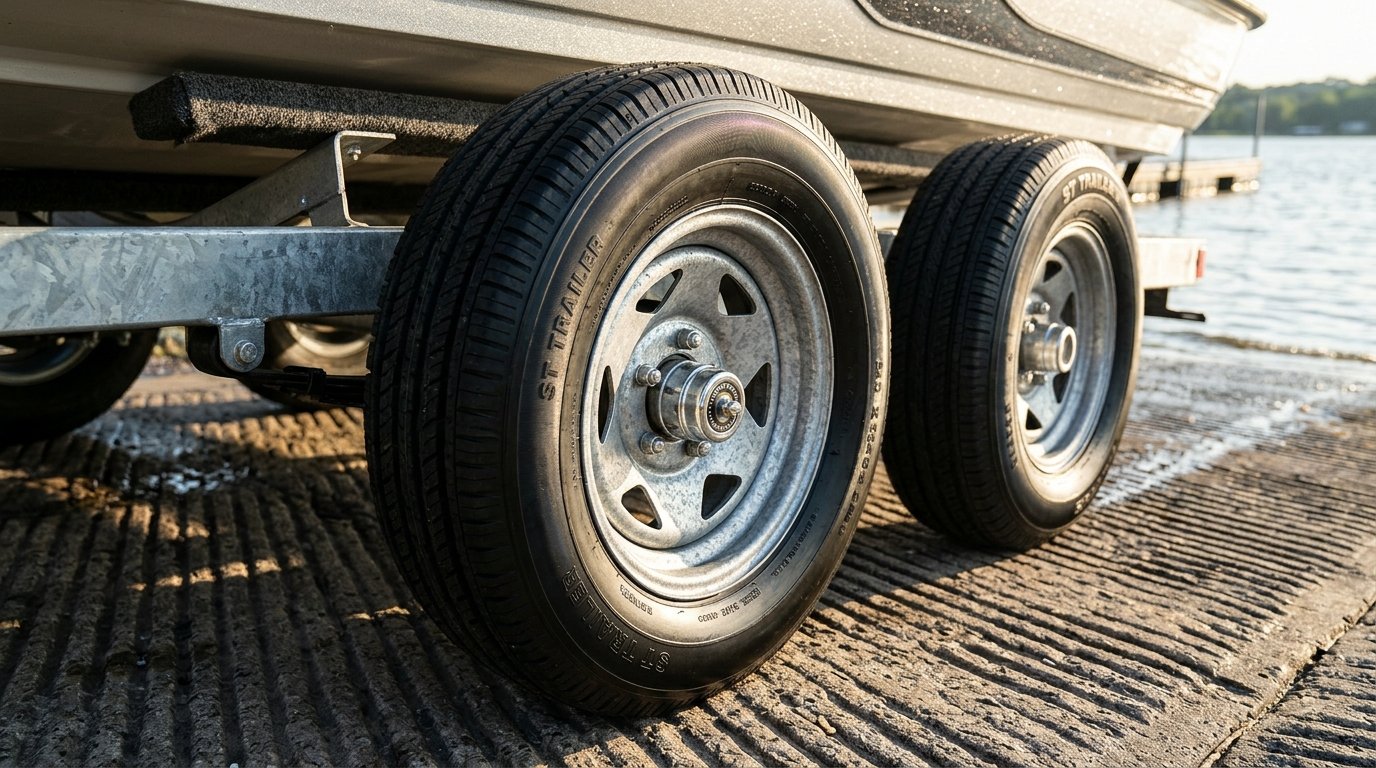
Tires: Why You Must Never Use Passenger Car Tires
Boat trailers require purpose-built Special Trailer (ST) designated tires, never passenger car (P) or light truck (LT) tires:
- ST tires feature thicker, stiffer sidewalls with extra nylon reinforcement to resist swaying and fish-tailing under high tongue weight.
- Always inflate ST tires to the maximum cold PSI listed on the tire certification label (often 50 PSI for Load Range C, 65 PSI for Load Range D). Under-inflated trailer tires generate extreme internal heat that leads to catastrophic highway blowouts.
- Check the 4-digit DOT manufacturing date code on the tire sidewall (e.g., “2422” means the 24th week of 2022). Regardless of remaining tread depth, boat trailer tires must be replaced after 5 to 6 years due to internal UV dry rot and rubber fatigue.
Trailer Brakes & Winch Strap Safety
Trailers with gross vehicle ratings over 3,000 lbs are required by law in most states to feature functional brakes on at least one axle:
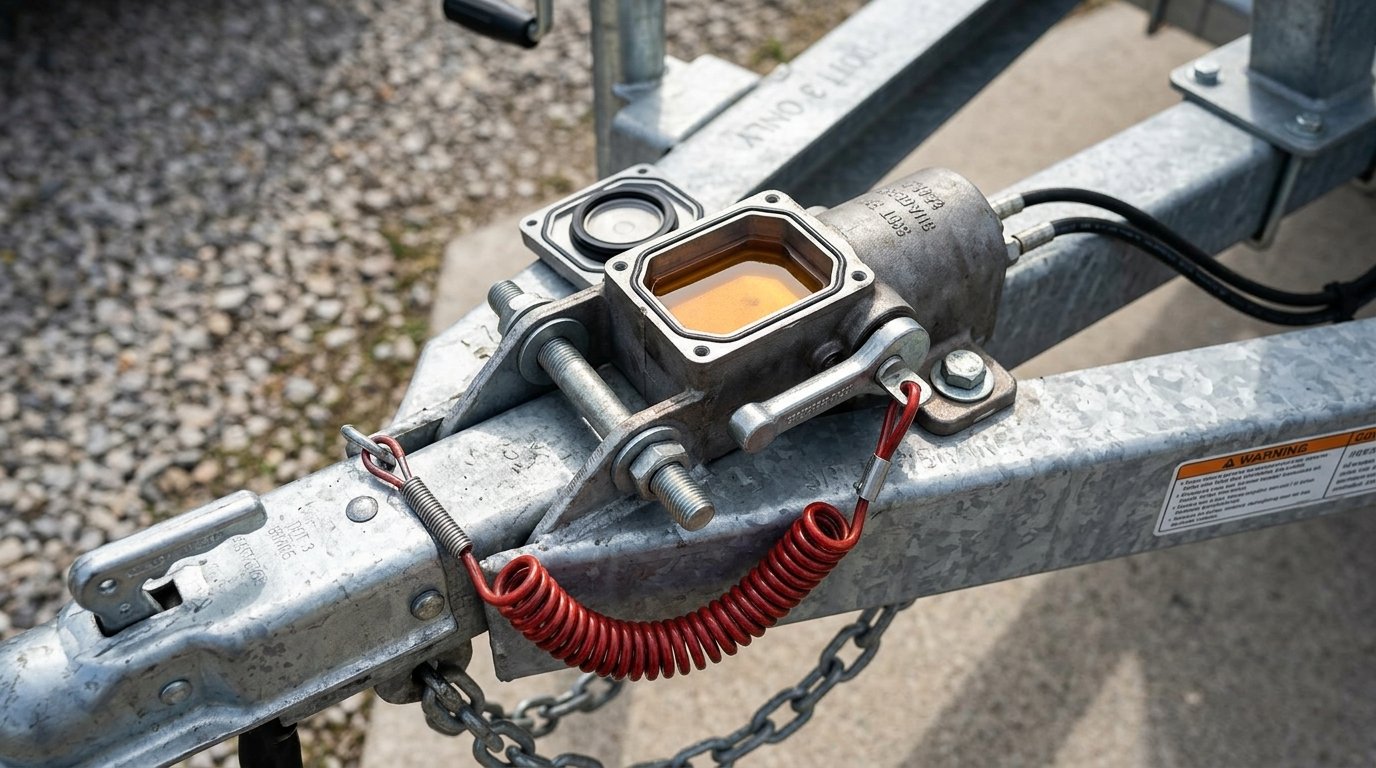
- Hydraulic Surge Brakes: The trailer coupler slides backward against a master cylinder when your tow vehicle slows down, creating hydraulic pressure that activates disc brake calipers. Periodically inspect the brake lockout solenoid (used for backing up) and flush contaminated brake fluid.
- Winch Strap & Safety Chains: Inspect the polyester winch strap for fraying or sun fading. Always cross your steel safety chains in an “X” pattern beneath the trailer tongue so that if the coupler unlatches from the hitch ball, the chains cradle the tongue above the pavement.
- Check our related guides for boat storage costs and marine electrical systems for tow vehicle wiring harness standards.
When planning your annual budget, accurate boat trailer maintenance metrics help you avoid unexpected expenses and extend vessel longevity.
Frequently Asked Questions About Boat Trailer Maintenance
How hot should boat trailer wheel hubs get after driving?
After driving at highway speeds for 30 minutes, touch your trailer wheel hubs with your bare hand. Properly lubricated hubs should feel lukewarm (between 100°F and 130°F). If a hub is too hot to hold your hand against comfortably (above 150°F), the bearings are dry, overtightened, or suffering immediate failure.
Do I need to unplug trailer lights before backing into the water?
If your trailer is equipped with modern sealed submersible LED lights, unplugging is usually unnecessary. However, if your trailer utilizes older incandescent bulbs, always unplug the vehicle trailer harness before submersion. Hot glass bulbs instantly shatter when hit by cold water, blowing fuses.
How often should boat trailer leaf springs be replaced?
In freshwater, steel leaf springs can last 8 to 12 years. In saltwater environments, leaf springs typically require replacement every 3 to 5 years. Replace springs immediately if you see flaking rust layers (exfoliation) or sagging arch height that causes tires to rub against the trailer fender wells.
What is the correct tongue weight for a boat trailer?
Proper tongue weight should be between 10% and 15% of the total loaded boat and trailer weight. Insufficient tongue weight (under 7%) causes dangerous high-speed trailer sway, while excessive tongue weight overloads the tow vehicle rear suspension and lifts front steering tires.
Published by Boat Maintenance Guide Editorial Desk. Compiled according to National Association of Trailer Manufacturers (NATM) and ABYC H-2 safe trailering standards. For certified engineering specifications, consult official protocols published by National Association of Trailer Manufacturers (NATM).
Following this proven boat trailer maintenance strategy protects your marine investment, enhances safety on the water, and minimizes unexpected mechanical repairs. For ongoing maintenance schedules and certified specifications, revisit our boat trailer maintenance recommendations each season.