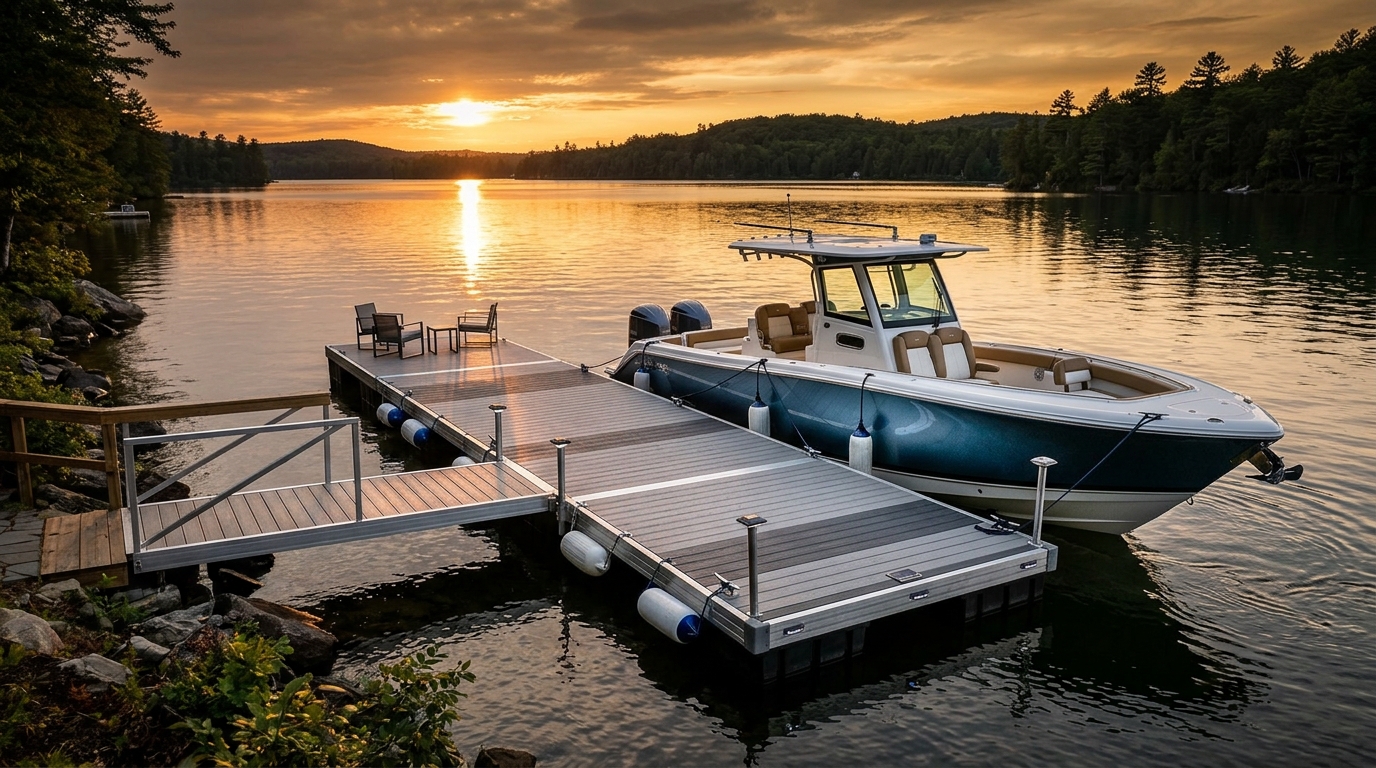
Installing and securing a private waterfront dock in lakes or tidal bays where water depths exceed 15 to 30 feet presents unique structural engineering challenges. Traditional pilings driven into the lakebed become prohibitively expensive or structurally unstable when water fluctuates significantly. Executing disciplined floating dock anchoring in deep water ensures your floating platform remains centered, stable, and storm-proof without twisting or breaking free during seasonal flood surges or severe wave chop.
Whether you manage a private lakefront retreat on a hydroelectric reservoir or a coastal tidal inlet with 10-foot vertical swings, choosing the right system for floating dock anchoring in deep water requires balancing anchor deadweight mass, chain scope geometry, stiff-arm shore struts, and marine-grade galvanized hardware. Below, waterfront marine contractors explain the proven engineering methods.
Primary Systems for Deep Water Floating Dock Anchoring
In shallow water under 8 feet, simple steel pipe legs or driven wooden pilings suffice. However, for floating dock anchoring in deep water (depths between 15 and 50+ feet), marine engineers rely on three specialized anchoring architectures:
| Anchoring Architecture | Ideal Depth & Water Environment | Holding Mechanism | Pros & Engineering Trade-Offs |
|---|---|---|---|
| Crossed Heavy Bottom Chains & Concrete Anchors | 15 to 45+ feet; fluctuating reservoirs | 1,000 to 3,000 lb pre-cast concrete deadweight blocks on lake floor | Superior wave absorption; crossed “X” pattern prevents lateral dock sway during boat wake impacts. |
| Shore Stiff-Arm Struts & Diagonal Cable Guy Wires | 10 to 30 feet; steep drop-off shorelines | Telescoping galvanized steel or aluminum pipe arms pinned to concrete shore seawall | Holds dock at fixed distance from rocky shoreline; dock hinges up and down smoothly with water levels. |
| Helical Lakebed Screw Anchors & Elastic Ropes | 20 to 60+ feet; sandy/muddy bottom | Hydraulically torqued steel helical plates screwed 8ft into lakebed + Seaflex/Hazelett elastic tethers | Environmentally friendly; zero chain drag across lakebed; smooth progressive tensioning. |
Federal guidelines enforced by the U.S. Army Corps of Engineers (USACE) mandate that all underwater anchoring systems must withstand regional 50-year storm flood levels and high-velocity wind loads without impeding navigable channels.
Calculating Chain Scope & Deadweight Anchor Sizing
The single most common mistake in floating dock anchoring in deep water is using chain that is cut too short. Just like anchoring a boat, a floating dock relies on chain catenary curve (the downward sag of heavy steel links) to cushion sudden wave shocks:
- The Scope Ratio Rule: In deep water with minimal water fluctuations, maintain a chain scope ratio of at least 3:1 to 5:1 (for example, in 20 feet of water at high pool, each anchor chain should be 60 to 100 feet long). In reservoirs with dramatic 15-foot seasonal drawdowns, calculate scope based on the 100-year maximum flood pool elevation.
- Deadweight Mass Sizing: Concrete loses approximately 40% of its effective weight underwater due to buoyancy displacement. A 1,000-lb dry concrete block weighs only roughly 600 lbs submerged! For a standard 20x24ft two-slip floating dock, marine contractors recommend a minimum of four 1,500 to 2,500 lb concrete anchor blocks (one for each corner).
- Crossed “X” Pattern: Never run chains straight out perpendicular to the dock. Always cross the chains beneath the dock in an “X” geometry. When a northwest wind blows against the starboard side, the crossed chain running to the opposite anchor goes into straight tension, locking the dock rock-solid.
Hardware Selection: Galvanized Steel & Mousing Wire
Saltwater and freshwater mineral environments degrade substandard hardware rapidly. When assembling your anchoring gear:
- Hot-Dipped Galvanized Chain: Use minimum 3/8-inch or 1/2-inch Grade 30 or Grade 43 hot-dipped galvanized steel proof coil chain. Never use electro-galvanized or zinc-plated chain, which will rust through within 18 months.
- Shackle Safety (Mousing): Underwater anchor shackles experience continuous cyclic wave vibration that will back out the threaded pin over time. Always secure the shackle pin to the shackle bow using stainless steel or copper mousing wire wrapped tightly through the pin hole to lock it permanently.
- Rubber Shock Snubbers: Incorporating heavy EPDM rubber mooring snubbers into the top chain connection absorbs the shock loads generated when 50-foot wakeboard boat wakes hit the dock slip.
For comparative dock styles, installation permits, and floating cube options, consult our comprehensive boat dock guide: floating vs. fixed dock costs, and explore our master boat storage cost guide.
Frequently Asked Questions About Floating Dock Anchoring in Deep Water
How do I adjust anchor chains when water levels drop in winter?
In lakes with seasonal autumn drawdowns, install chain tensioning winches (come-alongs or manual ratchet dock winches) mounted inside the corner dock framing. As the lake level drops, take up the slack chain to prevent the dock from drifting excessively; in the spring, let out chain before seasonal rains arrive.
Can I use old engine blocks or car rims as floating dock anchors?
No. Using automotive scrap, steel barrels, or old machinery as dock anchors is illegal under federal Clean Water Act regulations and local Department of Natural Resources (DNR) codes. Leaking petroleum residue harms aquatic habitats, and irregularly shaped scrap provides poor, unpredictable holding power compared to flat-bottomed precast concrete blocks.
Why is my floating dock tilting to one side in deep water?
Dock tilting (listing) in a chain-anchored system usually indicates that one anchor chain has either snagged on an underwater tree stump, or the opposing anchor block has shifted or dragged downhill along a steep underwater shelf, pulling that corner down under continuous tension.
Do I need a permit to drop concrete anchor blocks in deep water?
Yes. Any structure or deadweight placed on the bed of public waters, navigable rivers, or Army Corps reservoirs requires a shoreline activity permit. Anchors must be mapped and verified so they do not obstruct commercial navigation channels or underwater utility pipelines.
Published by Boat Maintenance Guide Waterfront Construction Desk. Inspected in accordance with U.S. Army Corps of Engineers (USACE) shoreline guidelines and American Boat and Yacht Council (ABYC) marine standards.