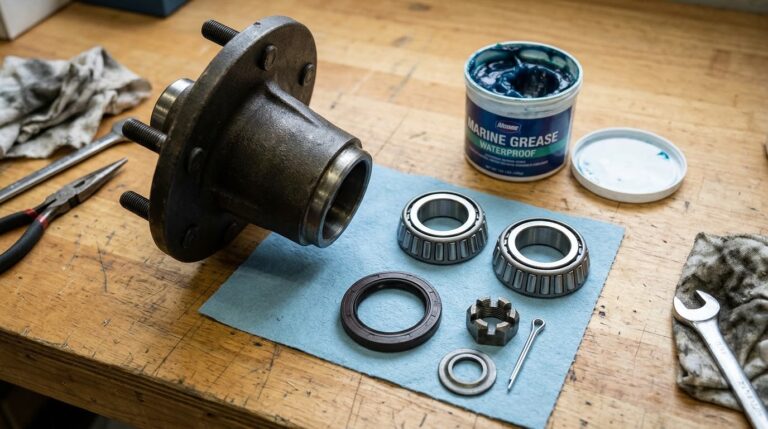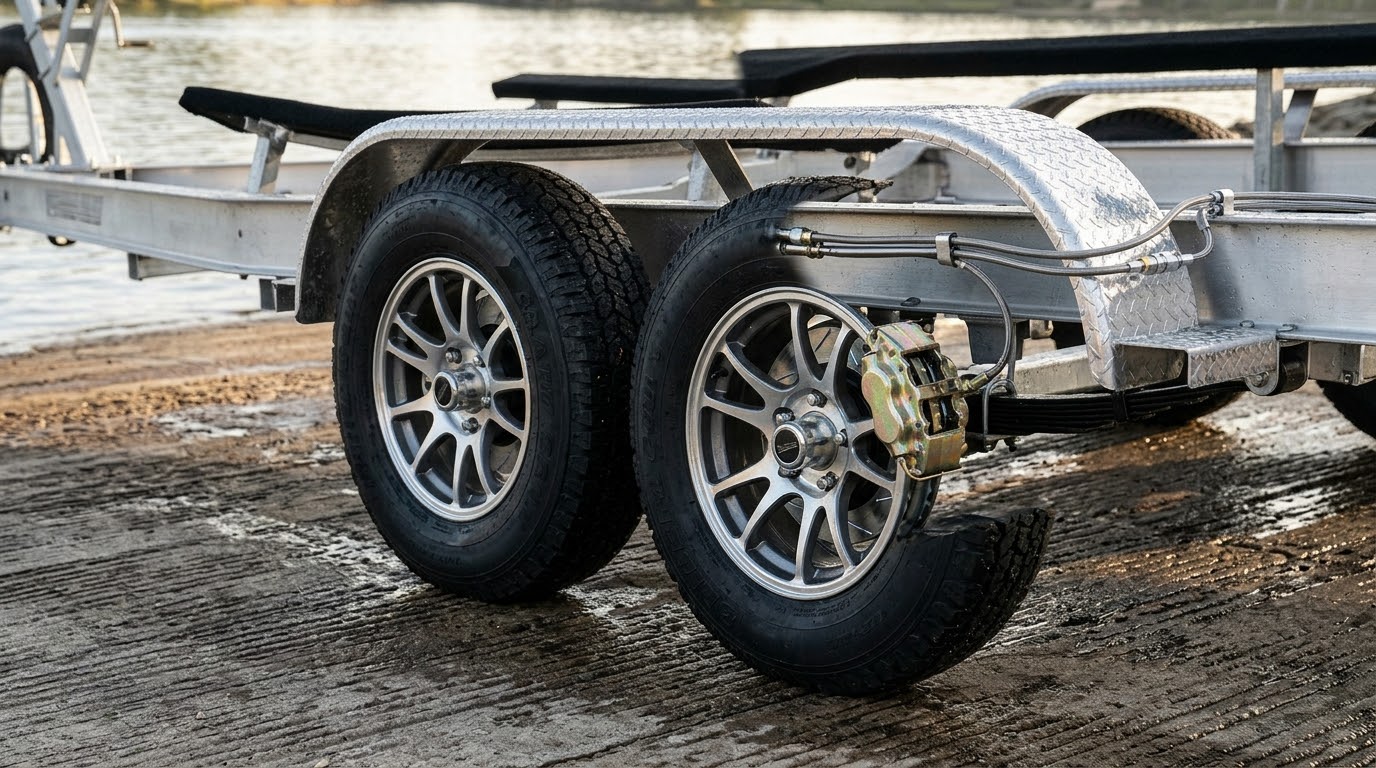
Towing a 4,000 to 10,000-pound boat and trailer down a steep mountain pass or executing an emergency stop on a rain-slicked highway demands absolute confidence in your braking system. Understanding the mechanics, differences, and maintenance requirements of boat trailer brakes is paramount to highway safety. Relying solely on your tow vehicle’s factory brakes to halt a heavy boat rig will overheat truck rotors, boil brake fluid, and significantly increase stopping distances.
Most state departments of transportation (DOT) require functional trailer brakes on any trailer with a gross vehicle weight rating (GVWR) exceeding 3,000 pounds. Choosing between traditional hydraulic surge brakes and modern Electric-Over-Hydraulic (EOH) systems for your boat trailer brakes impacts stopping control, backing-up convenience, and saltwater durability. Below, certified trailer specialists break down the complete engineering comparison.
Surge Hydraulic Brakes vs. Electric-Over-Hydraulic (EOH) vs. Electric Drum
Unlike utility or travel trailers that use dry electric magnets, marine trailers face complete water submersion at boat ramps. This hostile operating environment dictates the three primary categories of boat trailer brakes:
| Brake System Type | Activation Mechanism | In-Cab Stopping Control | Best Boating Application |
|---|---|---|---|
| Hydraulic Surge Brakes | Trailer tongue slides into master cylinder as tow vehicle decelerates | None (Mechanical inertia only) | Standard small-to-midsize boats (under 6,000 lbs); universal truck compatibility |
| Electric-Over-Hydraulic (EOH) | Electronic pump pressurizes hydraulic lines via in-cab controller | Instant proportional braking with manual emergency lever | Heavy offshore boats (7,000 to 18,000+ lbs); triple-axle tournament rigs |
| Direct Electric Drum Brakes | Electric magnets expand brake shoes against inner drum walls | Proportional electric in-cab control | Dry land utility trailers only! Strictly forbidden in saltwater marine use. |
According to construction guidelines established by the National Association of Trailer Manufacturers (NATM), Electric-Over-Hydraulic (EOH) delivers the fastest stopping reaction times (under 0.2 seconds), eliminating the clunking sensation and slight braking delay inherent in traditional mechanical surge couplers.
Disc Brakes vs. Drum Brakes: The Saltwater Verdict
When selecting running gear for your boat trailer, the choice between disc and drum brakes is clear-cut:
- Marine Disc Brakes (The Industry Standard): Disc brakes feature an open caliper and flat rotor design. When dunked in lake or ocean water, water sheds instantly within one wheel revolution. Caliper pads wipe the rotor face clean, delivering consistent 100% stopping power. In saltwater trailering, always specify dacromet-coated or 316 stainless steel calipers with stainless slide pins to prevent rust seizure.
- Marine Drum Brakes (Outdated Technology): Drum brakes enclose shoes, return springs, and wheel cylinders inside a cast-iron bowl. When submerged, saltwater becomes trapped inside the drum. The springs rust, brake shoes drag, and heat cannot dissipate, leading to brake fade and seized wheels within two seasons.
The Reverse Lockout Solenoid: Backing Up Without Locking Brakes
One of the most frequent headaches boaters encounter with hydraulic surge boat trailer brakes occurs when backing up a steep driveway or ramp: the backward force pushes the trailer coupler against the master cylinder, locking the trailer brakes solid!
Modern surge couplers incorporate a 5-pin flat or 7-pin round wiring harness connected to an electric reverse lockout solenoid. When you shift your tow vehicle into reverse, the truck’s reverse light circuit energizes the solenoid, opening a bypass valve that dumps hydraulic fluid back into the reservoir rather than pressurizing the calipers. If your trailer brakes lock in reverse, inspect your 5-pin blue wire or insert the manual steel lockout key into the coupler slot.
Step-by-Step Brake Fluid Flushing & Bleeding Protocol
Brake fluid is hygroscopic (absorbs moisture from humid marine air). Over two years, moisture lowers the boiling point of DOT 3/4 brake fluid, causing internal rust on caliper pistons. Bleed and flush your trailer brake lines every 24 months:
- Clean the top of the actuator master cylinder and remove the filler cap. Siphon out dark, oxidized fluid and refill with fresh DOT 3 or DOT 4 synthetic brake fluid.
- Attach a clear vinyl hose to the bleeder screw on the caliper farthest from the actuator (rear curb side), submerging the opposite end of the hose in a bottle of clean fluid.
- Using an actuator bleeder lever or a flat pry bar, stroke the master cylinder pushrod slowly to build hydraulic pressure. Open the bleeder valve 1/4 turn to expel air bubbles and dark fluid, then tighten before releasing the pushrod.
- Repeat the process on every wheel caliper, working from farthest to closest, until crystal-clear fluid with zero air bubbles streams through the clear tubing.
For complete running gear maintenance, pair this inspection with our boat trailer wheel bearing replacement guide and review our master boat trailer maintenance checklist.
Frequently Asked Questions About Boat Trailer Brakes
Do boat trailer brakes work in reverse?
Traditional surge brakes are designed to activate only under forward deceleration. Without an operational electric reverse lockout solenoid, pushing the trailer backward into a driveway or up a slight ramp will compress the coupler, locking the brakes. EOH systems bypass this issue automatically through the truck’s in-cab controller.
How hot should boat trailer brake calipers get while towing?
After highway driving with normal stops, trailer disc brake rotors should feel warm to moderately hot (typically 120°F to 160°F). If a rotor or wheel hub exceeds 200°F, smells of burning friction material, or emits smoke, the caliper slide pins have corroded and the brake pads are dragging continuously.
Can I wash my boat trailer brakes with freshwater after launching in saltwater?
Yes. Installing an on-trailer freshwater brake washdown kit allows you to connect a garden hose at the boat ramp to flush salt crystals directly off calipers, rotors, and pads. Flushing salt within an hour of retrieval triples caliper lifespan.
What is the minimum brake pad thickness for trailer disc brakes?
Replace trailer disc brake friction pads when the lining wears down to 3/32 inch (approximately 2.5mm) of remaining pad material. Allowing pads to wear down to bare steel backing plates will score and ruin expensive rotors.
Published by Boat Maintenance Guide Towing & Trailer Desk. Inspected in accordance with National Association of Trailer Manufacturers (NATM) and ABYC H-2 trailer safety standards.